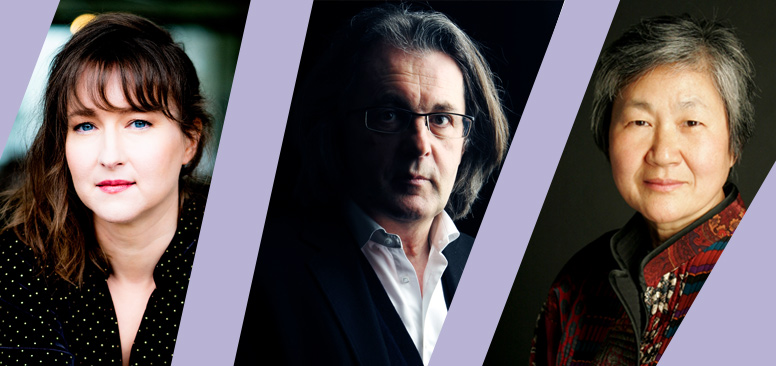
Metamorphosis is a theme that has enjoyed an extraordinary degree of success in every branch of the arts, from the literary metamorphoses of Apuleius, Nicander, Ovid, Kafka and Mary Shelley, to the figurative representations - especially of the myth of Apollo and Daphne - that fascinated Bernini, Tiepolo, Giorgione and Piero del Pollaiolo, to its translation into music by composers like Peri, da Gagliano, Schütz and Richard Strauss.
Today Silvia Colasanti offers a new interpretation. Commissioned by the 75th Festival del Maggio Musicale Fiorentino, the world premiere of this work will be performed on Tuesday 22nd May at the Teatro Goldoni in Florence (Additional performances on 24th and 25th).
The literary source for Silvia Colasanti’s opera is Franz Kafka’s famous story The Metamorphosis (written 100 years ago), which tells the story of Gregor Samsa (Edoardo Lomazzi), a travelling salesman who wakes up one morning to find that he has been transformed into a giant insect. Rejected by his horrified family, Gregor dies shut up within his own room.
The stage director is Pier’Alli, who also wrote the libretto and realised the scenery, costumes, lighting and video images. The orchestra of the Maggio will be conducted by Marco Angius.
From May 18th to May 31th, Teatro Carlo Gelice in Genua will stage a new version of “Che fine ha fatto la piccolo Irene?”, chamber opera by Marco Betta, libretto by Rocco Mortelliti after a novel by Andrea Camilleri
Marco Stroppa’s first venture into music theatre goes on stage at the Opéra Comique in Paris on 19th May 2012: Re Orso (for 4 singers, 4 actors, ensemble and electronics), on a libretto by Catherine Ailloud-Nicolas and Giordano Ferrari. Based on a fable written in a refined verse by Arrigo Boito in 1865, the piece tells the story - obscure and mysterious - of the cruel Re Orso who reigned over Crete in the long distant past, soiling his reputation with crimes and excesses of every sort. Making use of electronics Stroppa brings out the vitality of the story in the form of a macabre dance. The work will be performed together with Ensemble Intercontemporain under the direction of Susanna Mälkki. The stage direction is by Richard Brunel.
The production has been realised in collaboration with the Théâtre de la Monnaie, IRCAM and Ensemble Intercontemporain. There will be two additional performances on 21st and 22nd May.
“Ja sam”, literally “I’ll do it by myself”, is the nickname that Sergei Rachmaninoff’s family gave him when he was a child. The study of the human and artistic nature of this composer is what lies at the heart of Ja sam, the sonata for orchestra and boys’ choir that the Filarmonica della Scala has commissioned from Matteo Franceschini.
The piano was for Rachmaninoff the corner stone of his artistic activity and the essence of his work. Departing from this awareness, Matteo Franceschini investigates the formal modalities and practical means that the Russian composer used to deal with musical material, maintaining the piano as background and source for his own writing. This translates into a distinctive colouring of the orchestra and the choir, treated here as a timbre and not as a distinct group, and the strict structure of the piece’s sonata form (exposition, development and recapitulation), regenerated here by the studied exchange between the two composers.
The world premiere of Ja sam will be performed on 7th May 2012 by the Filarmonica della Scala and the theatre’s boys’ choir under the direction of Andrea Battistoni.
| When | May 06, 2012 07:30 PM
to
Jun 02, 2012 07:30 PM |
|---|---|
| Where | Antwerpen and Gent |
| Add event to calendar |
Le Duc d’Albe is one of the most fascinating enigmas in the history of Italian opera. Written by Donizetti in 1839 for the Opéra de Paris on a libretto by Scribe and Duveyrier, the composer chose not to complete the work following upon a series of contrasts with the management of the theatre. Completed in Italian by Matteo Salvi in 1881, the opera had never been staged in its original form. Now thanks to a commission from the Vlaamse Opera, to the studies of the musicologist Roger Parker and to the creativity of Giorgio Battistelli, who has composed the missing parts and the finale basing himself on the original libretto, the figure of Fernando Alvarez de Toledo, better know as the Duc d’Albe, the ferocious 16th century governor of the Spanish Netherlands, has finally regained the tragic grandeur that Donizetti wished to bestow upon him.
World premiere on 28th April in Witten (Wittener Tage für Neue Kammermusik) for Mauro Lanza’s Der Kampf zwischen Karneval und Fasten for string octet. With this piece inspired by Pieter Brueghel’s famous painting the composer continues his exploration of ‘complex and unstable sonoric phenomena ’. Just as in the painting there is an opposition between contrasting images (meat/fish – banquet/fasting – tavern/church) so in this new work a contrast is effected both through a simple opposition of musical elements and through an allegory of the dialectic between law and life, between speculation and real sound.
An extremely satisfying April for Silvia Colasanti, protagonist on 19th at the Auditorium in Milan with the world premiere of her Concerto per violoncello e orchestra (additional performances on 20th and 22nd). Fruit of her encounter and subsequent collaboration with the Lithuanian cellist David Geringas, the Concerto is intended to link up with tradition through a dialectic of dialogue and contrappostion between soloist and orchestra, using a form and language deeply immersed in the present. The concerto will be performed by the Giuseppe Verdi Symphony Orchestra of Milan together with David Geringas under the direction of Aziz Shokhakimov.
In addition, on Saturday 14th April at the Teatro Brecht di San Sisto in Perugia there will be a revival of the children’s music theatre work Il sole, di chi è?, which Silvia Colasanti wrote in 2008 on a text by Roberto Piumini. The performance, which also makes provision for the active participation of the children present, will mark the conclusion of the foundation Amici della Musica’s project “Musica per crescere” (Music to grow) and will be interpreted by the Polimnia Ensemble together with the singer-actors from Musicamorfosi.
The 31st Franco Abbiati Critics’ Prize for Best New Work in 2011 has been awarded to Luca Francesconi’s QUARTETT, the opera commissioned from the composer by the Teatro alla Scala.
The following is the statement released by the jury:
"Performed and staged in a superb manner, the score makes very effective use of the famous text by Heiner Müller, from which the composer drew the libretto.
The complex conception of the work involves a combination and interweaving of the extreme mobility of the writing for the instrumental group positioned in the orchestra pit (which installs an extremely flexible and sinewy relationship with the agile variability of the vocal inflections) and the broad sweep of the sound of the hidden, full orchestra and choir, which give voice to dimensions that are quite distinct from the “closure” of the deadly game for two played out by the protagonists."
World premiere for Mauro Lanza in Brest (France): on 5th April the piece La bataille de caresme et de charnage for cello and piano will be performed by Séverine Ballon on cello and Vincent Leterme on piano. It will be played as part of a concert, ‘Voyage en Italie’, that Ensemble Sillage will perform in the concert series ‘Le Quartz, Scène nationale de Brest’.
Born in Venice, Mauro Lanza is a tireless experimenter with sound that is tied to noise and electronic music: “What I look for in music is the alien, something that leaves me disoriented”.
La bataille de caresme et de charnage has been commissioned by Ensemble Sillage and the Akademie Schloss Solitude in Stuttgart.
From the 15th March to 30th April the Italian School of Senology will be promoting “Primavera abruzzese. 99 volte in rosa” (Spring in Abruzzo. 99 times for women”), a series of training and awareness-raising initiatives in relation to the prevention and treatment of breast cancer. The programme includes many important cultural events, including a number of musical ones. On 21st March in the inaugural concert in Aquila the Orchestra Sinfonica Abruzzese conducted by Claire Gibault will perform amongst other works Silvia Colasanti’s Cede pietati, dolor. Le anime di Medea.
Fabio Vacchi has composed a new melologue for the initiative, Il Piacere di leggere, with a text by Dacia Maraini.
Il piacere di leggere will be performed at the Teatro Comunale in Teramo on Friday 23rd March by the Solisti Aquilani under the direction of Alessandra Rossi, with Luca Marcossi on piano and the reciting voice of Lella Costa. There will be an additional performance on 31st March at the Teatro Marrucino in Chieti, preceded by an introductory conference with Dacia Maraini and Fabio Vacchi.
From 19th to 25th March the Orchestra della Svizzera Italiana will dedicate a series of initiatives to Azio Corghi on the occasion of his 75th birthday. The programme, realised in collaboration with Rete Due (Network 2) of the RSI (Italian Swiss Radio), involves 3 concerts – including a number of Swiss premieres – master classes and meetings at the studios and auditorium of the RSI in Lugano.
The first musical event is dedicated to children. Thus on 19th March at the Auditorio della RSI the musical fable Le due regine will be performed. Based on an idea byDario Moretti, the production features Sonia Bergamasco and the Naqqara Ensemble conducted by Maurizio Ben Omar. This will be followed on 23rd March by a concert in which the Orchestra e il Coro della Svizzera Italiana, conducted by Enrique Mazzola, will perform Cruci-Verba (a reading from and commentary on José Saramago’s The Gospel According to Jesus Christ, performed over Franz Liszt’s Via Crucis) with Sonia Bergamasco as reciting voice.
Corghi’s week-long presence at the OSI will conclude on 25th March with Un petit train de plaisir (a ballet from Giacomo Rossini’s Péchés de vieillesse) in the version for 2 pianos, 6 percussion and reciting voice. The text by Quirino Principe will be recited by the actor Claudio Moneta while the Ensemble 900 from the Conservatory of Italian Switzerland will be conducted by a student from the course in orchestral conducting.
The world premiere of Giorgio Battistelli’s PACHA MAMA, a piece for orchestra performed by the Sinfonieorchester Münster under the direction of Fabrizio Ventura, will take place on 6th March in Münster. PACHA MAMA, “Mother Earth” in the language of Quechua, expresses the desire to delve into the biological laws governing life by way of a journey into the song of the earth, into the expression of matter united with the dimension of reflection and the spirit. A journey divided into three movements without interruption, from the immersion in matter, entrusted to the harmonic dimension of the piece, to the song of PACHA MAMA in the high register of the strings. The piece has been commissioned by the KlangZeitFestival 2012.
The act of conducting as an inner need is brought to the stage in Giorgio Battistelli’s Sconcerto, one of the composer’s most frequently performed works, to be staged in Milan at the Teatro Strehler on 16th, 17th and 18th March and featuring the orchestra of the Pomeriggi Musicali under the direction of Marco Lena.
The stage is occupied by an orchestra together with its conductor (played by the actor Toni Servillo), who, engulfed by the inexorable flow of his own thoughts, would like to give back some order to them through music. His search for sense torments him, giving rise to a myriad of moods and emotions. While the orchestra at times seeks to guide these towards a solution, inevitably still others rise up like an insurmountable wall, as though to bring out the limited nature of the word as against musical expression and its possibilities.
How can an element of musical discourse, be it pitch, timbre or phrasing, take on different functions in the course of its unfolding, yet still remain true to itself? How can a form in a painting remain the same albeit regenerating its function in relation to the other figurative elements? These are the questions that lie at the basis of Unfolding, the piece for string quartet and electronics that Francesca Verunelli composed on commission from IRCAM in 2011 and that will be performed for the first time by the Arditti Quartet on 6th March at the Biennale ‘Musiques en Scène’ in Lyon. The piece will be performed again in Paris (at the Cité de la Musique) on 10th June as part of the Festival Agora.
The world premiere of Unfolding also marks the beginning of Francesca Verunelli’s collaboration with Casa Ricordi. Francesca obtained a diploma in piano and composition at the Cherubini Conservatory in Florence and in 2007 went on to do advanced studies under Azio Corghi at the Accademia S. Cecilia in Rome. In 2008 she undertook the Cursus at IRCAM. Her compositions have been performed by the Orchestre National de Lorraine, Ensemble Intercontemporain, the Nouvel Ensemble Moderne di Montréal and Accroche Note among others. She was awarded the Leone d’argento at the Biennale in Venice in 2010. Recently she has received commissions from Radio France and Ensemble Court-Circuit (Commande d’État) for two works that are scheduled to be performed in 2013.
Ingo Metmacher will conduct the Staatsopernchor and the Staatskapelle Berlin with the direction by Katie Mitchell at Staatsoper im Schiller Theater from March 1st to 11th
In the same days, in the Kraftwerk of Berlin Mitte an exhibit on the work concept and creation with documents from the Nono Archive in Venice will take place
| When |
Feb 17, 2012
from 09:00 PM to 11:00 PM |
|---|---|
| Where | Turin, Auditorium Rai |
| Add event to calendar |
The final concert in the eighth Rai NuovaMusica concert series, to take place on Friday 17th February 2012 at the Auditorium della Rai in Turin, features the world premiere of Giorgio Battistelli’s latest work Tail up. The piece was composed on commission from the Orchestra Sinfonica Nazionale della Rai, which will be conducted for the occasion by Susanna Mälkki.
The title Tail up refers to the exhortation with which the mother of the great British writer Virginia Woolf used to encourage her daughter to overcome the little trials of everyday life. Battistelli tells us that “It’s an expression that immediately struck me when it was suggested to me by my writer friend Nadia Fusini, a excellent English-speaker and an authority on the writing of Virginia Woolf”.
The score is made up of four parts that – in keeping with the title - reciprocally spur each other on in a context of great dynamism; the various sections of the orchestra, reacting to the impulses of the harmony and the rhythm, confront each other with out-and-out whips of the tail - “a metaphor of how vital it is to know how to keep your tail up high and straight, to look at reality with the necessary degree of detachment”.
| When |
Feb 11, 2012
from 05:00 PM to 07:00 PM |
|---|---|
| Where | Stuttgart Theaterhaus |
| Add event to calendar |
Inquiry, oriented towards the recovery of a sense beyond the gesture, the phoneme, noise, which made its entry onto the music scene last century, is the founding element that gives rise to Herzstück, for six voices, a piece which Luca Francesconi has written for the Neue Vocalsolisten and whose world premiere will take place on 11th February 2012 at the Theaterhaus in Stuttgart as part of the Festival ECLAT Neue Music.
Francesconi assumes a critical stance in relation to the whole of the musical output of the 20th century, which, starting out from twelve-note composition, resulted in a deconstruction of musical language itself (and not just that), arriving today at the loss of a shared meaning, breaking up into niches that are so numerous and changeable that they risk excluding the individual from any type of relationship whatsoever. Today the sense of the word is swallowed up by and englobed in the noise of the world.
A close attention to the semantic value of the text of the German poet and dramaturg Heiner Müller is the point of departure for this search in Herzstück, together with the recovery of the “sacrality” of the word through music.
The interpreters of the premiere in Stuttgart will be Sarah Maria Sun, Susanne Leitz-Lorey, Truike van Der Poel, Martin Nagy, Guillermo Anzorena and Andreas Fischer.
| When |
Feb 10, 2012
from 09:00 PM to 11:00 PM |
|---|---|
| Where | Turin, Auditorium Rai |
| Add event to calendar |
“Are portraiture and individuality inextricably linked?” It is starting out from this reflection that the Marco Stroppa, has sketched Ritratti senza volto (Portraits without a face) three paintings for orchestra in which, in his own words, the subject of the work, the “face”, is the orchestra itself “in the form of a human and sonoric body with a myriad of facets”.
The first painting is entitled ‘La Gravità’ and the composer tells us that this image should be understood both in a physical sense, as force of attraction, and in a psychological sense, as severity. The piece comes to life out of the depths of the orchestra in a turbid, furrowed atmosphere, against which there alternates five times a second “face”, made up of flickers of sonority in the medium-to-high register, brought out by two sharp-edged melodic lines that confront each other in increasingly complex polyphonies above the staticity of the initial idea.
The second piece, ‘L’isolamento’, remains in a context of duplicity, which on this occasion counterposes a sonoric amalgam that opens out into a sparkling sonority and a sextet of two oboes and a quartet of strings that performs a fully fledged piece of chamber music; the two faces are synthesised in a slow, multiple glissando that leads without interruption to ‘L’Apesanteur’ (the third painting). This third piece provides for the orchestra to be divided up into 13 instrumental groups each of which, in a very quick, overall gait, performs a distinct piece of music, as though a panoply of tiny portraits that come together to make up a single face.
The Italian premiere of Ritratti senza volto will take place on 10th February 2012 at the Auditorium Rai in Turin and will be performed by the Orchestra Sinfonica della Rai under the direction of Pascal Rophé. The world premiere of the work was performed on 10th May 2007 by the Orchestre de Paris under the direction of John Axelrod.
| When |
Feb 05, 2012
from 05:00 PM to 07:00 PM |
|---|---|
| Where | Paris, Théâtre du Châtelet |
| Add event to calendar |
At 5 p.m. on Sunday 5th February at the Théâtre du Châtelet in Paris a new music theatre work dedicated to young audiences: Zazie dans le métro for voices and orchestra. Based on Raymond Quenau’s 1959 novel of the same name, it tells the story of a little girl, Zazie, who journeys from the countryside to Paris to visit her uncle Gabriel, bringing with her a long-cherished dream: to visit the Paris underground!
This desire catapults her into a thousand different adventures amid the streets of the capital, from the flea market to the Eiffel Tower, but without resulting in her managing to catch even a glimpse of the corridors of the mythical underground railway! Nevertheless, out of this experience the twelve-year-old Zazie discovers the world of adults, which she, full of audacity, is able to unmask and call into question.
The music of Zazie, on a libretto by Michel Beretti, is the work of the Italian composer Matteo Franceschini. It is among the numerous commissions that the composer has received in the course of his current appointment as composer in residence at the Orchestre National d’Ile-de-France. The score features a soprano (Sevan Manoukian), a baritone (Jean-Baptiste Dumora) and an actor (Guillaume Marquet); the musical direction has been entrusted to Mélanie Lévy-Thiébaut, while the stage direction is by Christian Gagneron.
Born in Trent in 1979, Franceschini completed his musical training at IRCAM in Paris, and today moves comfortably between composition for instruments, vocal composition and electronic music.
On 22nd January (additional performances up to 1st February) the Grand Théatre de Genève will perform the Swiss premiere of Giorgio Battistelli’s Richard III, a music drama in two acts based on Shakespeare’s tragedy of the same name. The libretto is by Ian Burton. Richard III was performed for the first time in Antwerp in 2005 under the direction of Robert Carsen and with scenery by Radu Boruzescu and costumes by Miruna Boruzescu. The same production was revived at the Deutsche Oper Am Rhein in Düsseldorf in 2007 and later, in 2009, at the Opéra National Du Rhin in Strasbourg and now once again at the Grand Théatre de Genève, where the Basel Sinfonietta and the opera house’s choir will be conducted by Zoltan Pesko. The playwright Ian Burton has reduced Shakespeare’s historical tragedy to a very powerful libretto, which constitutes a study in the strategies of power and cruelty. Battistelli’s music, which has long expressed a keen interest in the legends rising up around the figure of Richard III, translates Burton’s gloomy enquiry into a rich and varied musical language, which unites a gift for invention with a solid and precise formal structure, giving life to an extremely impelling dramaturgical rhythm.